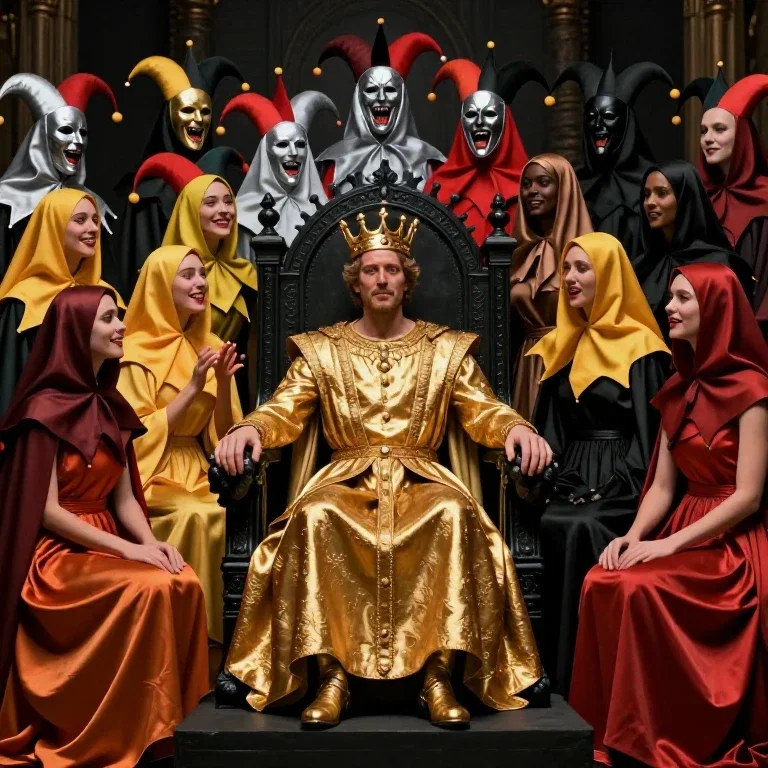
The king and his properties
A Critical Examination of Neo-Marxism and Its Inventors Political correctness, the pervasive and often stifling culture of conformity that dominates Western societies today, has its roots in the neo-Marxist ideologies that emerged in the aftermath of the First World War. This movement, often referred to as "Western Marxism," was spearheaded by a group of intellectuals who sought to adapt Marxist theory to the changing political and social landscapes of the 20th century. Among the most influential figures in this movement were György Lukács, Ernst Bloch, Antonio Gramsci, Karl Korsch, and the collective known as the Frankfurt School. A critical examination of their work reveals a pattern of intellectual manipulation and ideological control that has had a profound and often detrimental impact on Western thought. The Genesis of Political Correctness: Neo-Marxism’s Cultural Infiltration Today the term “political correctness” is often dismissed as a right-wing caricature, but its origins reveal a darker reality: a deliberate, century-long project by neo-Marxist intellectuals to subvert Western civilization. Following the failure of socialist revolutions in Europe after World War I, Marxist thinkers abandoned the proletariat and instead declared war on culture, language, and identity. The first of these developments was fascism; the second is today's wokeism. This ideological shift birthed the insidious framework of “wokeism” that now dominates academia, media, and corporate boardrooms. Neomarxism Political Correctness Wokeism The Post-WWI Pivot: From Class War to Culture War The Russian Revolution (1917) and subsequent uprisings in Germany and Hungary ignited hope among Marxists that capitalism would collapse under proletarian revolt. When these movements failed, theorists like Antonio Gramsci and Georg Lukács concluded that Western culture itself was the enemy. Capitalism, they argued, survived not through force but by indoctrinating masses with "bourgeois" values l
The king in gold arose from the black throne where he had been seated for hours, and asked what had caused the uproar. In imitation of the emaciated king, the women, whores, concubines, jesters, and priests wore unchanging faces of silver, iron, bronze, wood, and fabric. And the jesters’ masks gaped with laughter, while the priests’ were black with concern. Fifty merry faces blossomed to his left, and to his right fifty sad faces scowled. The bright fabric stretched over the heads of the women mimed endlessly graceful faces enlivened by artificial smiles.