Scopri
Modifica
Video
App
Prezzi
Discussioni
Accedi
Accedi
Home
Scopri
Galleria
Galleria capsule
Modifica
Video
App
Prezzi
Discussioni
Tema
Chiaro
Scuro
Sistema
Lingua
1
1
Segui
Segui
34
opere
89
mi piace
0
Follower
0
Seguiti
Iscritto il 2026
opere
34
Album
0
Recenti
Popolari
Vista
1
1
1
1
1
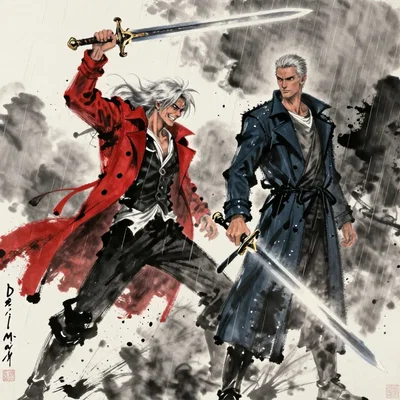
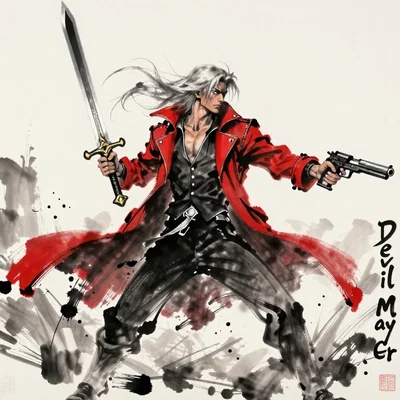
Ink-wash freehand style, bold and powerful brushstrokes, rice paper texture, calligraphic brushwork, and the spirit of stone inscriptions. The painting depicts the fateful showdown between the twin brothers Dante and Virgil— On the left: Dante (silver-white long hair flowing, crimson long trench coat with a black vest underneath, right hand raised high holding the Rebellion greatsword, the sword’s momentum fierce as it slashes downward, the hem of his coat swept with dry brush and flying white, his expression unruly and bold, a smile on his lips). On the right: Virgil (silver-white short hair combed neatly back, dark blue long trench coat, holding the Yamato sword—its slender blade rendered with light ink and white space to show its sharpness, its scabbard outlined with bold black lines, his expression cold and merciless, eyes like ice, posture steady as a pine). Dense diagonal rain streaks cut through the scene, both their robes soaked by the rain, water splashes and ink dots flying where the blades meet. Dante’s white hair hangs damply, Virgil’s face remains stern. The background is gloomy, with darker, wetter ink, blending the sadness of the rainy night with the brothers’ hatred and love. The background alternates between light ink and large areas of white space, where heaven and earth merge, symbolizing the entanglement and opposition of the brothers’ fate. The painting is full of dynamic tension and tragic beauty, perfectly integrating the pathos of fratricide with the freehand style of ink-wash. On one side of the painting, the calligraphy “Devil May Cry” is inscribed, adorned with a red seal.
1
1
1
1
2
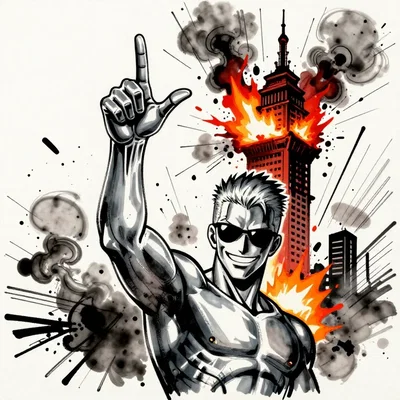
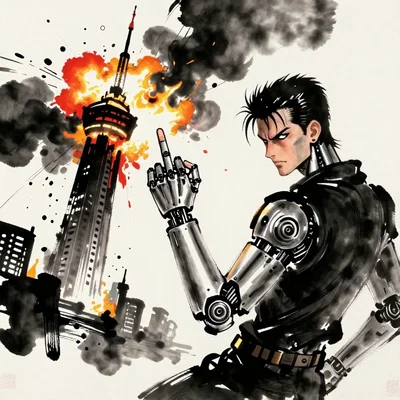
The bold, cursive ink style blends with cyberpunk aesthetics, with the texture of rice paper and a dynamic composition. In the center of the image, Johnny Silverhand is making his iconic rebellious gesture: he raises his silver left arm, flips the bird, pointing directly at the exploding and burning Arasaka Tower in the background. Johnny's face is outlined with bold strokes, his eyes covered by sunglasses, and there's an unruly smile at the corners of his mouth. Silverhand's metallic luster is rendered with dry brushwork and light ink leaving blank spaces, and the muscle lines of his arm are depicted with short, bold strokes to show tension. The Arasaka Tower in the background has an incomplete twin-tower structure, with explosion flames in the middle section of the tower (rendered in ink shades and dark red/orange tones rather than bright colors), and thick smoke billowing (depicted as masses formed by interlacing thick ink and blank spaces). A large number of ink splatters convey debris and sparks. Diagonal bold lines simulating raindrops intersect with explosive shockwaves, filling the image with a dynamic sense of fragmentation.
1
1
1
1
1
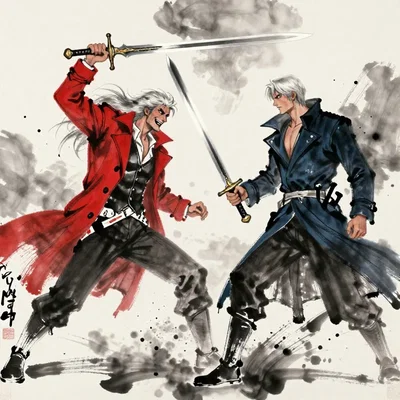
The style is ink-wash freehand brushwork, with bold and vigorous brushstrokes, the texture of rice paper, calligraphic brushwork, and the spirit of stone engravings. The painting depicts the fateful duel between Dante and Vergil, the twin brothers — Left side: Dante (with fluttering silvery-white long hair, a long bright red trench coat, a black vest underneath, holding the Rebellion greatsword high in his right hand, the sword slashing sharply downward; the hem of the coat is swept with dry brushwork and whitewash, his expression is unruly, a smile on the corner of his mouth). Right side: Vergil (with neatly combed silvery-white short hair, a dark blue long trench coat, holding the Yamato katana. The slender blade is rendered with light ink and white space to show its sharp edge; the scabbard is outlined with bold lines of thick ink. His expression is cold and deadly, eyes like ice, posture as steady as a pine). The two swords cross at the center of the painting, where the blade tips meet, forming the visual focus. Abundant ink dots and whitewash brushstrokes radiate outward. Dante stands on the left, Vergil on the right, their coats and hair blowing away from each other. Suitable for square or horizontal composition. The background alternates between light ink and large areas of white space, with heaven and earth merging, symbolizing the entanglement and opposition of the brothers' fate. The painting is filled with dynamic tension and tragic beauty, perfectly integrating the pathos of brothers fighting each other with the freehand spirit of ink wash. On one side of the painting, the calligraphy "Devil May Cry" is inscribed, accompanied by a red seal.
1
1
1
1
1
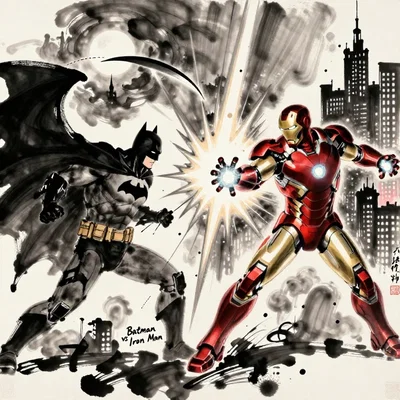
The ink-wash freehand style features rough and powerful brush strokes, rice paper textures, calligraphic brushwork, and the noble spirit of stone inscriptions. The artwork depicts an epic battle between Batman and Iron Man. On the left is Batman: His black cape unfurls like bat wings, rendered with dry-brush and flying-white strokes. His entire dark armored suit is outlined with heavy ink to define its angular contours, while the cowl’s pointed ears tower above, revealing his jawline. Behind him lies a Gothic nightscape of swirling dark clouds and a waning moon. On the right is Iron Man: His red-and-gold armor uses burnt ink and negative space to convey metallic texture. The arc reactor in his palm and chest is rendered with blank dots and light ink radiating lines to depict light, with stark geometric lines and bold angular strokes defining the armor’s segmented panels. Behind him stretches a scene of city neon and starry skies. The two clash at the center of the composition: Batman throws a batarang, its flight path suggested by blank curved lines and subtle ink trails, while Iron Man retaliates with a repulsor blast, depicted as radiating thick ink lines and flying-white strokes representing the energy beam. The batarang and beam collide at the canvas’s core, sending ink splattering and bursting outward in all directions. The ground merges Gotham and New York-style city nightscapes, with dense short thick ink lines forming the silhouettes of buildings. The bold contrast of ink shades is striking: Batman’s side is dominated by dark, deep tones, while Iron Man’s side features bright, light whites, creating the ultimate juxtaposition of "light and shadow." Large areas of blank space interweave with heavy ink, exuding power and grandeur. In one corner of the artwork, the calligraphy "Batman vs Iron Man" is inscribed, accented with a red seal. This piece fuses the Oriental freehand style with the epic nature of American comic book heroes.
1
1
1
1
4
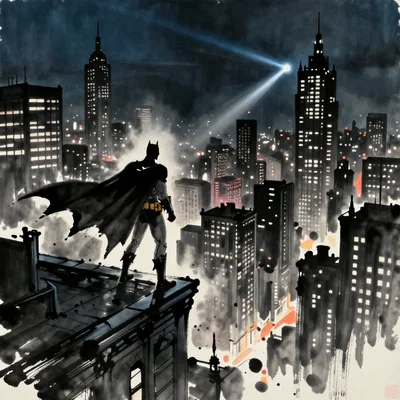
Chinese ink style, Batman stands on the edge of a skyscraper roof, at night in Gotham City, overlooking the entire city from above, his black cape fluttering in the wind, side view of his back, freehand ink wash rendering, bold and rich ink application, splashed ink brushstrokes, dominated by dark gray, black and deep blue, faint glimmers of city lights, mist lingering in the rainy night, silhouettes of tall buildings, the distant Bat-signal piercing through the dark night sky, Chinese style negative space, cinematic atmosphere, dark and moody lighting, grand cityscape, freehand character, not realistic photographs, rice paper texture, ink wash texture, sophisticated composition, movie shot.
1
1
1
1
2
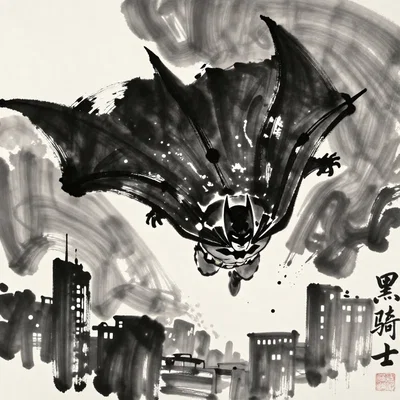
In the grand style of "xieyi" (freehand) with bold-brush ink and the texture of rice paper, Batman dives down from the night sky of Gotham, with his enormous black cape as the visual focus. The cape is rendered with sweeping large strokes using the side of the brush, combining thick ink with dry brushwork that leaves white space, its edges fragmented like bat wings (scattered ink dots and dry brushstrokes), while the paper's weave is depicted with bold curves to convey tension and folds. The Batman figure is compacted at the center of the cape (the pointed-eared cowl is outlined with bold lines using the center of the brush, and his body is in a forward-leaning diving pose). Above the background is the Bat-Signal (a sector-shaped light beam left in white space), and below lies the Gotham city skyline (dense short, thick vertical lines and light ink dots). The ink is dominated by thick and concentrated ink, with auxiliary light ink, and large areas of white space set off the cape's tension. The overall feel is sharp, swift, dark and solemn. In one corner of the painting is the calligraphy "黑暗骑士" (Dark Knight) paired with a red seal, blending the grand style of Eastern ink wash with the dark-night hero of Gotham.
1
1
1
1
4
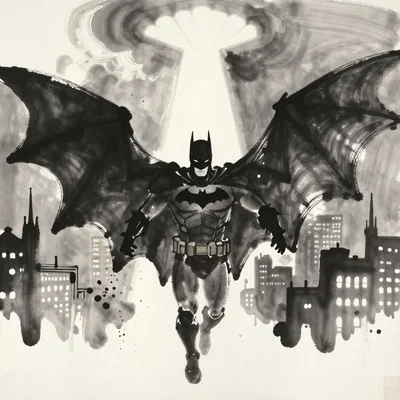
Ink-wash grand freehand style, with bold and forceful brushstrokes and lines, the texture of rice paper, calligraphic brushwork, and the artistic conception of stone rubbing. The painting takes Batman’s cape as the absolute visual subject — The cape occupies most of the frame. Using thick ink and dry brush with flying white strokes to sweep out a huge bat-wing shape, its edges extend in fragmented forms toward the four corners of the painting (expressed with scattered ink dots and flying white brushstrokes). The folds and tension of the fabric are outlined with bold lines on the cape, as if being violently tugged by the night wind. Batman’s figure is reduced to the center of the cape — his dark armor is outlined with simple thick lines, the pointed cowl is sharply defined, and his body is in a diving pose (arms outstretched, legs drawn back), forming a compositional relationship of "central core + outstretched wings" with the cape. Background: Gotham’s night sky — above Batman, a searchlight bat signal pierces through the clouds (rendered as a fan-shaped pillar of blank space), while below lie distant city lights (depicted with dense pale ink dots), and spires of Gothic buildings are subtly dotted in the cityscape with short, thick ink lines. The ink colors are dominated by thick and焦墨 (burned ink) for the main part of the cape, with pale ink for the background city, and large areas of blank space (the night sky) that accentuate the cape’s tension and dynamism. The overall atmosphere is sharp, swift, dark yet imbued with a touch of heroic pathos.
1
1
1
1
2
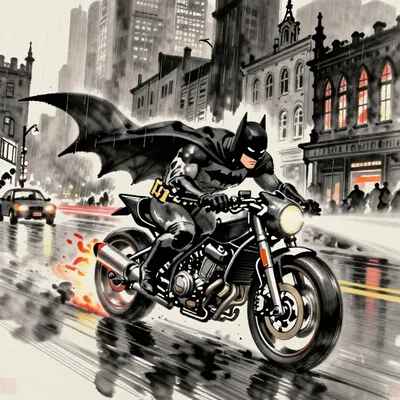
Ink wash painting style with freehand brushwork, bold and powerful ink lines, rice paper texture, calligraphic brushwork, and the vitality of stone inscriptions. Batman rides the Batcycle speeding through the wet streets of Gotham City. Main subject: Batman—his black cape billows backward in the high-speed movement (the streamlined trajectory of the cape is rendered with dry brushstrokes featuring blank spaces of paper), his dark armor is outlined with thick ink, his cowl with pointed ears is lowered and leans forward, his white goggles are depicted with blank space, and his body crouches low against the bike, presenting a “ground-hugging flight” dynamic. Batcycle—The slender, streamlined body is outlined with bold ink lines; the front wheel is wide, while the rear wheel is compact; the front armor extends forward like a bat’s outstretched wings; the exhaust pipe emits flames (rendered with ink and shades of dark red/orange); the headlights cast a fan-shaped beam of light (depicted with blank space and light ink). Background: Gotham’s night scene—Gothic-style buildings and skyscrapers stand on both sides of the street (rendered with dense, short, thick vertical lines and ink blocks); the wet road reflects the neon and vehicle lights (blended with light ink and wet brushwork); oblique raindrops run through the entire painting with fine ink lines; a streaking motion blur is depicted with light horizontal lines on the roadead. The contrast between light and dark ink is striking—the foreground uses thick and concentrated ink to portray Batman and the Batcycle, while the background employs light ink and washes to depict the city and rain curtain. The overall atmosphere is cold, fast-paced, and dark, showcasing the sharpness and dominance of the “Dark Knight of Gotham.” In one corner of the painting, the calligraphy “Gotham” or “Dark Knight” is inscribed, accompanied by a red seal.
1
1
1
1
5
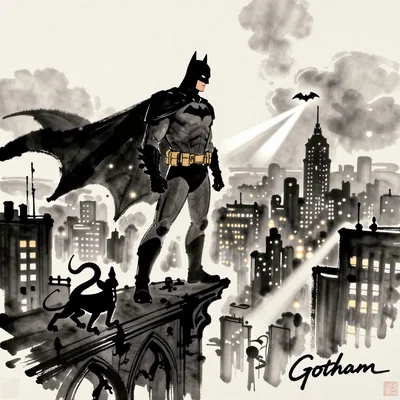
Ink wash bold freehand style, rough and powerful ink brushstrokes, rice paper texture, calligraphic brushwork, and the rhythmic spirit of stone inscriptions. Batman stands atop a gargoyle on a high-rise building in Gotham City, gazing down at the entire city from a bird's-eye view— Main subject: Batman. His black cape is swept to one side by the night wind (the outline and folds of the cape are rendered with dry, flying-white ink strokes), his dark armor is sketched with bold ink lines, his pointed ears on the cowl tower high, his jawline defined by thick lines, and his white goggles are represented as blank dots for the eyes. His body leans slightly forward, presenting a vigilant posture of "ready to leap at any moment." Beneath his feet: the gargoyle— a classic decoration of Gothic architecture. It is outlined with bold, thick ink lines to form its beastly shape, crouching on the edge of the building, echoing Batman's guardian posture. Background: Gotham's nightscape. In the distance, silhouettes of skyscrapers and towers are rendered with dense, short and thick ink lines combined with light ink washes. Scattered warm glows from windows are depicted as tiny dots of light ink, and a beam of the Bat-Signal shines through the clouds, represented by a blank fan-shaped light beam with a bat silhouette. There is a strong contrast between dense and light ink. The foreground Batman is mainly rendered with deep and burnt ink, while the background city is done with light ink and washes. Large areas of blank space create the night sky and a sense of depth. The overall atmosphere is lonely, solemn, and vigilant, showcasing the responsibility and solitude of the "Dark Knight Guardian." In one corner of the painting, the calligraphy "Gotham" is inscribed, accented with a red seal.
1
1
1
1
2
Ink wash painting in the style of freehand brushwork, with bold and forceful ink lines, the texture of rice paper, calligraphic brushwork, and the vitality of stone inscriptions. Dante (with long silver hair fluttering in the wind, wearing a long bright red windbreaker with a black vest underneath, and distinct muscle lines) stands in a combat stance in the center of the画面(picture). His right hand raises the Rebellion Sword (a two-handed sword as tall as a person, with the blade outline outlined with thick ink lines, and the guard rendered with bold, heavy brushwork), while his left hand holds one of the Ebony & Ivory handguns, with the muzzle pointing outside the画面(picture). The hem of the windbreaker is swept horizontally with dry brush and scattered ink, with dripping ink and full dynamism. The white hair is depicted with negative space plus light ink to outline the direction of the hair strands, and the red windbreaker uses alternating dense and焦墨(dark ink) to show the texture of the leather and the folds of the clothes. The contrast between light and dense ink is strong, the lines are fierce and powerful, and the large area of negative space sets off the "Devil Hunter"'s free and unrestrained demeanor. The background is rendered with light ink to depict the remains of battle or moonlight, and in one corner of the画面(picture) is calligraphy inscribed with the words "Devil May Cry", embellished with a red seal.
1
1
1
1
3
Johnny Silverhand, with his silver cybernetic arm, flips the middle finger, facing the exploding Arasaka Tower, with flames and debris all around. This intense action scene is rendered in a bold sumi-e ink wash style, featuring thick black ink, ink splatters, dark smoke, and a dramatic angle, conveying a defiant punk attitude and cyberpunk rebellion. --style raw --s 400 --ar 16:9
1
1
1
1
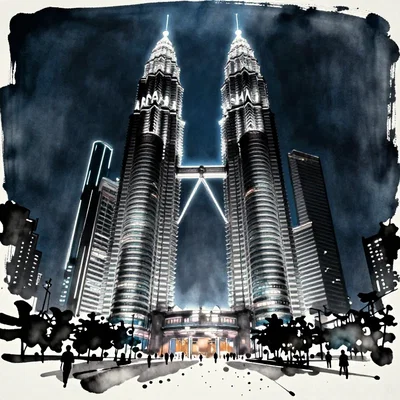
Bold ink wash meets cyberpunk style, with rice paper texture. Night view of the Arasaka Tower panoramic scene: the twin-tower detached skyscraper is rendered with large areas of bold ink, with sharp geometric outlines drawn only with thick black lines, dark glass and black steel beams merge into one. The backlit "ARASAKA" logo on the top of the tower is rendered with white space and light blue fluorescent halo, standing out strikingly in the night sky. The middle section of the tower is divided into two, and the connecting overpass is outlined with short thick horizontal lines. The corporate plaza at the base of the tower is depicted with light ink and fine dots, with sparse silhouettes of pedestrians and cool neon lights. The sky is deep ink blue, and the city’s halo shines through from behind the tower. Heavy ink tones dominate the composition, conveying a sense of coldness, bleakness, and power—a fusion of Eastern ink wash and cyberpunk oppressive aesthetics. From a low-angle upward perspective, the Arasaka Tower stands at the center of the frame, its twin-tower detached structure clearly visible. The tower-top logo occupies the highest point of the image, while the entire tower body is rendered in deep black with bold ink, with only cool blue light shining through at the top and the overpass. Scattered human figures (represented as ink dots) in the plaza at the tower’s base accentuate the tower’s immense scale.
1
1
1
1
1
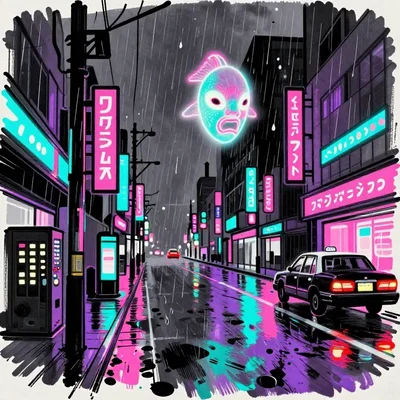
Bold ink brushstrokes blend with cyberpunk style, featuring rice paper texture. A close-up of a cyberpunk street on a rainy night: the wet asphalt road is covered with large areas of thick ink, and the puddles reflect the neon lights on both sides (pink, cyan, and purple are used to depict the reflections with wet brushstrokes). The buildings on both sides of the street are outlined with bold ink lines, and their walls are covered with neon signs (signs in Japanese Katakana or Chinese characters, rendered with bold short brushstrokes and fluorescent colors). Holographic projection – a huge fluorescent carp or geisha mask floats above the street, rendered with light ink and cyan/pink, presenting a semi-transparent texture. Raindrops are depicted as dense, slender ink lines slanting across the画面. In the foreground are utility poles (bold black lines), vending machines (square zigzag lines plus light spots), or the trailing lights of taxi taillights (short red horizontal lines). The strong contrast between heavy ink and fluorescent colors weaves together the wet and cold urban atmosphere and the warm neon glow, embodying a blend of futuristic vibe and earthly charm.
1
1
1
1
4
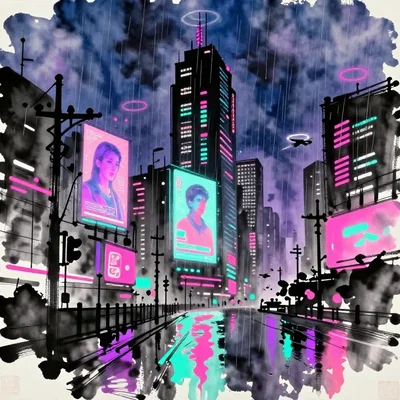
Bold brushstrokes, ink wash, cyberpunk style, rice paper texture, and calligraphic technique are integrated. The picture presents a panoramic view of a rainy night in a futuristic metropolis: towering skyscrapers are outlined with thick black ink lines, their surfaces covered with neon lights (dyed with fluorescent pink, cyan, and purple); huge holographic portraits or billboards float between the buildings (rendered with translucent light ink and fluorescent tones). Rain threads diagonally pierce the picture with dense thin ink lines, and puddles on the ground reflect the colorful neon lights (expressed through the flow of intermingled colored ink). The sky is rendered in deep ink blue and purple, with city halos seeping through the clouds. In the foreground are bold silhouettes of utility poles, traffic lights, or drones. The strong contrast between dark ink and fluorescent colors embodies both the freehand flow of ink wash and the cold prosperity of cyberpunk.
1
1
1
1
2
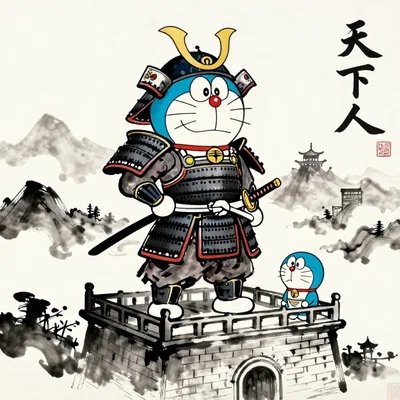
In the bold, freehand style of ink wash painting, characterized by vigorous and powerful brushstrokes, rice paper texture, calligraphic brushwork, and the spirit of stone inscriptions, the central scene features Doraemon (a round, blue-and-white robotic cat without ears, with a plump face and large eyes) wearing the armor of a daimyō samurai of Japan’s Sengoku period: a dō-maru gusoku (black or dark blue lacquered armor trimmed in gold, with a circular family crest on the chest, broad square shoulder armor), a kabuto helmet decorated with a golden crescent or staghorn ornament on the front and fukigaeshi (cheek guards) on both sides of the face, and a magnificent jinbaori overgarment. Standing majestically at the uppermost level of a tenshukaku (castle keep), Doraemon grips a katana at his waist with one hand, places the other hand on his hip or rests it on the balustrade of the keep, gazing far into the distance. The background is rendered with light ink washes to depict distant mountains and city walls, surrounded by swirling sea of clouds. There is a sharp contrast between dark and light ink tones, with bold, forceful lines, while extensive negative space highlights the contrasting presences of a dignified warlord and a playful child. In one corner of the work, the calligraphic characters "天下人" (tenka-bito, meaning "master of the realm") are inscribed, accented with a red seal.
1
1
1
1
2
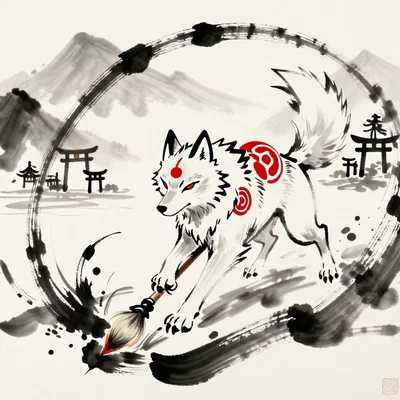
The style of large-ink-wash freehand brushwork, with vigorous and forceful ink lines, the texture of rice paper, calligraphic brushwork, and the charm of Japanese-style ink. In the center of the painting is the protagonist of "Ōkamiden"—Chibiterasu, a young white wolf, smaller and cuter than Amaterasu from the previous game. His whole body is outlined with bold ink lines, white fur is depicted with negative space, and the red magatama patterns on his back and head are accentuated with dense ink. Chibiterasu assumes the posture of unleashing "Brush Arts," with the divine brush's trail of flowing ink appearing under or in front of his paws, the ink forming arcs in the air like running water. The background is rendered with light ink washes to create a Japanese-style landscape—distant mountains, torii gates, or Japanese-style buildings, with large areas of negative space building the artistic conception of a "picture scroll world." Clear and intense ink tones interweave, lines combine vigorous strength with the fluidity of ink wash, perfectly recreating the unique Japanese-style ink-wash aesthetics of "Ōkamiden," with a red seal adorning one corner of the painting.
1
1
1
1
1
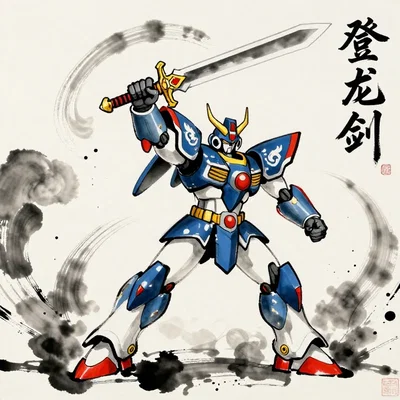
Ink Wash Freehand Style, bold and powerful brushstrokes and lines, rice paper texture, calligraphic use of brushwork, and the charm of stone inscriptions. At the center of the painting is the protagonist mecha of *Mashin Hero Wataru* — Ryujinmaru (classic blue, white and red color scheme, chibi proportion with two heads, golden horn on the top of the head, round dragon pattern on the shoulder armor, red magatama core on the chest, holding the Dragon Sword) in the initiating posture of a special move. The entire mecha is outlined with thick ink lines to form a solid silhouette, while the white armor is rendered with reserved blank space, and the blue and red areas are distinguished by light and dark ink tones. The Dragon Sword is raised high above the head, its blade depicted with reserved blank space and light ink arcs to show its sharpness, and the sword’s momentum brings along trailing ink blurs. The background is created with large areas of light ink and dry brushwork with flying white strokes to depict turbulent wind and clouds, with splattered ink dots enhancing the sense of dynamism. The ink is flowing and unrestrained, the lines are powerful and vigorous, and the large areas of reserved blank space set off the heroic spirit of "One Sword Breaks Ten Thousand Dharma". In a corner of the painting, the three characters "登龙剑" (Dragon Sword) are written in bold calligraphy, accented with a red seal.
1
1
1
1
3
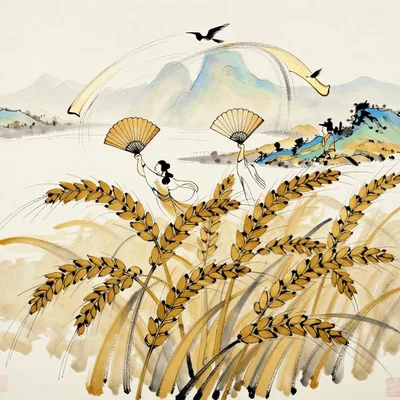
Bold Freehand Brushwork with coarse brushstrokes in ink and wash, in the painting the ears of grains (warm gold as the main tone, with the figures holding folding fans, their long sleeves fluttering) are swirling and dancing. When the water fan is waved, the water flow is transformed into spiritual birds and landscape scrolls (expressed with rough arcs and light ink washes). The lines are mainly curved, in contrast to the straight lines and angular folds of Qiu Yuan. The background outlines the outline of the blue-and-green landscape in the style of "A Thousand Li of Rivers and Mountains" with light ink (dominated by ink tone, with a little ochre), gentle yet with sharpness, graceful and grand.
1
1
1
1
2
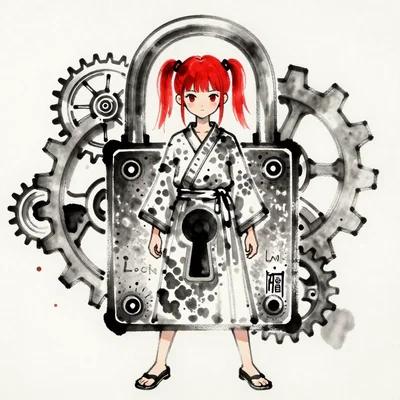
Bold freehand brushwork in ink and wash, "Lock Ming" (the red-haired girl with red eyes and twin tails) stands in the center of the picture, her whole body combines machinery and ink wash rendering. The metal lock is outlined with bold square lines, and the ink wash patterns on the robe are rendered with hazy ink tones. Behind her is a huge outline of mechanical gears (outlined with bold round lines), interwoven with scattered ink smudges, forming a unique visual contrast of "the collision of machinery and freehand brushwork".
1
1
1
1
3
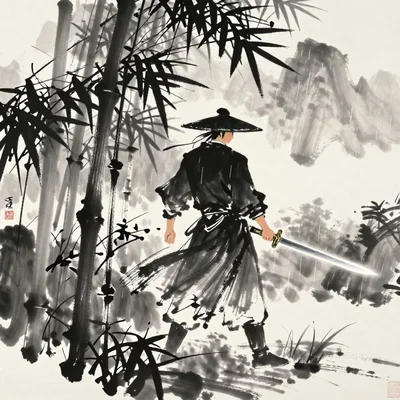
The bold, expressive brushwork of ink wash on Xuan paper, depicting the Wuthering Waves character Qiu Yuan (the lone swordsman, wearing a conical hat and black cloak, holding a sharp sword) standing in a stormy bamboo forest. The bamboo stalks are rendered with vertical, thick lines using the center of the brush tip, while the bamboo leaves are swiftly swept out with the side of the brush tip, resulting in a wet and vigorous ink effect. The sense of wind and rain is conveyed through dense, diagonal, thick lines. Qiu Yuan’s robe is painted with dry-brushwork featuring dry, faded strokes swept horizontally, and the cold glint of the sword’s edge is represented by a single line of negative space. The background uses light ink to wash distant mountains, with large areas of negative space contrasting to create a solitary, solemn atmosphere. There is a strong contrast between dark and light ink shades, and the lines are forceful and vigorous, showcasing calligraphic brushwork and the rhythmic spirit of stone inscriptions. In one corner of the artwork, the four characters “百折不摧” (Unbowed and Indomitable) are inscribed, accompanied by a red seal. The piece blends Chinese style martial arts with bold ink-wash painting, brimming with dynamic energy.
Previous
Next