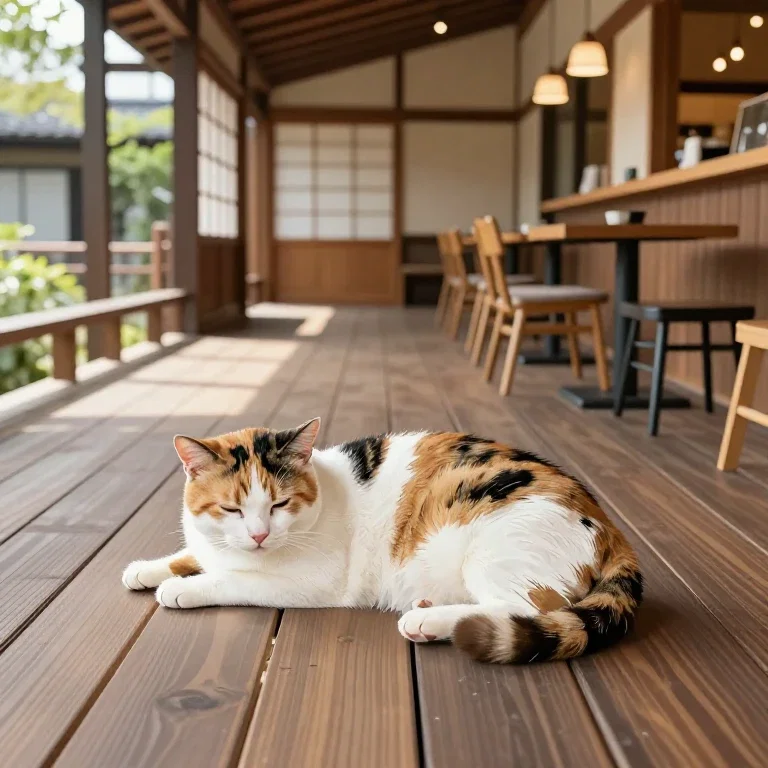
Composition first: It’s easier to create a relaxed vibe if you frame the scene from a slightly oblique, overhead view of the veranda. Place the cat slightly off-center, and it will look natural. Next, the large shapes: Start with the calico cat’s round back and gently curved tail. For a resting pose, a horizontally elongated oval for the body and a smaller circle for the head are enough. Face and pose: To convey a sense of relaxation, make the eyes look sleepy. Folding the front legs or extending just one forward creates a calm impression. The ears should not be too upright; softening their outward tilt makes them look gentle. Painting techniques for calico fur: Coloration tips: Using white as a base and placing large patches of brown and black will make it look like a calico cat. Avoid scattering the colors too finely, as this can look restless—instead, it’s easier to paint by adding color in solid areas on the back and around the face. Fur texture expression: First, lay down the patterns in solid blocks, then slightly jagged only at the edges to make it look feline. How to depict the veranda: Background essentials: The veranda can be conveyed simply by adding parallel lines of the floorboards. Adding a touch of shoji screens or garden greenery enhances the Japanese atmosphere. Including a bright strip of sunlight on the floor adds to the relaxed feeling. Instead of drawing everything with fur, the trick is to gently blur only a part of the outline. Inside a wood-grain café. First, draw the floor, walls, and ceiling as large shapes. Since depth is important in a café, deciding on the vanishing point using one-point perspective from the start helps keep things cohesive. Place large furniture pieces: Next, arrange the counter, table, chairs, and shelves in descending order of size. For a wood-grain café, a composition that features larger wooden surfaces rather than small, detailed items will create the right atmosphere. (work-design.co.jp) Add lighting: Finally, adding pendant lights, window light, and houseplants will instantly make it look like a café. It is noted that wood and wood-grain materials pair well with creating warm, bright spaces. (work-design.co.jp) Wood-grain tips: Do not overdraw lines: For wood grain, do not draw every detail—adding a few knots and loose flow lines is enough. Overworking the details can make it look like a pattern rather than real wood. Divide colors in two steps: Use a light brown as the base for wood color, then add reddish-brown or dark brown only on the shadow side for a natural look. Changing the colors of the floor, desk, and beams slightly prevents monotony. Adding wood-grain elements to backgrounds and small items is an example of how it can enhance the café atmosphere. (resketch-shop.co.jp) Composition first: It’s easier to create a relaxed vibe if you frame the scene from a slightly oblique, overhead view of the veranda. Place the cat slightly off-center, and it will look natural. Next, the large shapes: Start with the calico cat’s round back and gently curved tail. For a resting pose, a horizontally elongated oval for the body and a smaller circle for the head are enough. Face and pose: To convey a sense of relaxation, narrow the eyes or make them appear half-closed. Folding the front legs or extending just one forward creates a calm impression. The ears should not be too upright; softening their outward tilt makes them look gentle. Painting techniques for calico fur: Coloration tips: Using white as a base and placing large patches of brown and black will make it look like a calico cat. Avoid scattering the colors too finely, as this can look restless—instead, it’s easier to paint by adding color in solid areas on the back and around the face. Fur texture expression: First, lay down the patterns in solid blocks, then slightly jagged only at the edges to make it look feline. How to depict the veranda: Background essentials: The veranda can be conveyed simply by adding parallel lines of the floorboards. Adding a touch of shoji screens or garden greenery enhances the Japanese atmosphere. Including a bright strip of sunlight on the floor adds to the relaxed feeling. Instead of drawing everything with fur, the trick is to gently blur only a part of the outline. A calico cat comfortably sleeping on three stacked zabuton cushions. Creating the atmosphere of a traditional Japanese house: Add Japanese-style elements simply. Do not overwork every detail—focusing on key points will convey the "traditional Japanese house" vibe. Lightly draw tatami mat patterns with rectangles and thin parallel lines. Add wooden sliding doors or shoji screens with wooden frames to the back wall. Draw pillars and lintels with slightly thick lines. For wooden pillars and lintels, lines with subtle unevenness and shading will create the textured look of "well-used wood." For tips on drawing traditional Japanese house textures, explanations of traditional Japanese house process work can provide good references. A calico cat sleeping on three stacked zabuton cushions. (medibangpaint.com) Start with a simple rectangular prism: First, draw a zabuton as a "thick rectangle," then add wrinkles later. Round the edges of the zabuton slightly to convey softness. A cat with shimmering metallic highlights and abstract background, a luxurious vector template with high-gloss brilliance for the latest design trends.