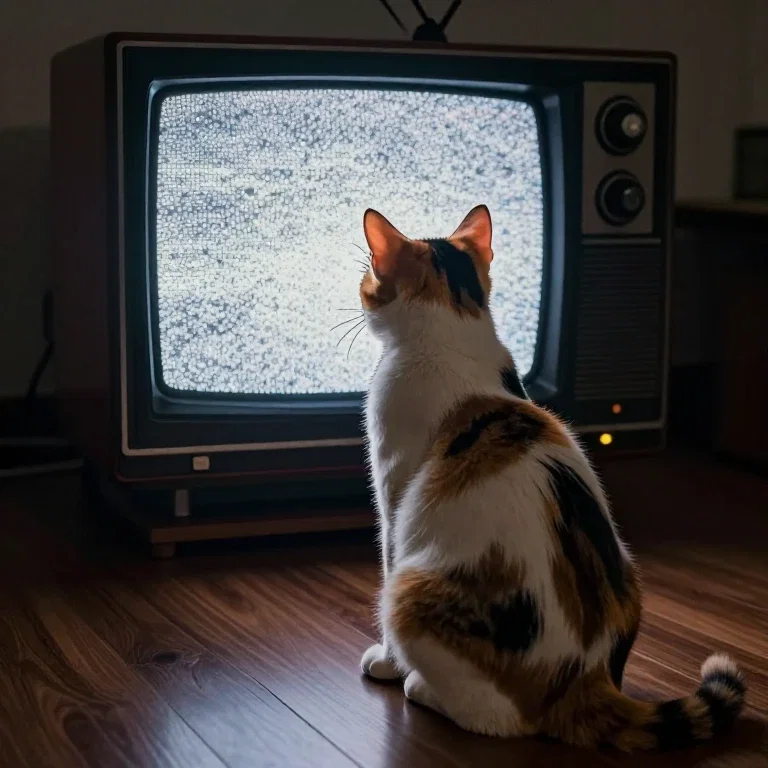
A calico cat stares intently at the static on a cathode-ray tube (CRT) television in a dimly lit room. The cat is sitting on the floor with its back to us, and the white noise from the TV illuminates its back and the tips of its ears. It has a Showa-era retro atmosphere, and a quiet, slightly mysterious vibe. The back view is the easiest to draw. If you draw the calico cat sitting in front of the CRT TV, slightly lifting its neck to gaze at the screen, it’s easier to create a focused look. When drawing the cat’s sitting posture, placing its weight on its hips will make it look natural. (medibangpaint.com) TV: Draw the main body as a square, and round the corners for the screen. Adding knobs and speaker holes will make it look more like a CRT TV. For the static screen, rather than putting small dots in evenly, creating a little unevenness will make it look more realistic. (retro-pop.pod-planning.com) Calico Cat: It’s easier to block out the cat’s body as a circle and a teardrop shape. The head is a circle, the torso is a large teardrop, the ears are triangles, and the tail is placed as a gentle curve. For the back view, making the hips slightly wider than the shoulders will make it look like a real cat. For the calico pattern, don’t scatter it all over the body—placing a large black patch on the back, and a brown patch near the head or ears will make it look cohesive. (youtube.com) The lighting will improve significantly if you draw only the light coming from the TV. By darkening the room and making only the cat’s back and the edges of its ears glow white, the sense of it intently staring will strengthen. It’s also effective to cast some of the screen’s light on the side of the face or the floor. As a reference image, there’s an example work of a back view of a cat staring at a retro TV.